

Author
Marie R. Winters


You can move your business toward sustainable packaging in five steps: assess your current packaging, set clear goals, compare materials on performance and cost, engage stakeholders, and start with small changes. This guide is a practical roadmap for decision-makers who need results without disrupting operations.
You will see how to weigh material options, meet compliance requirements, control costs, and build the internal business case for Sustainable Packaging Solutions. Peninsula Plastics recommends starting with one product line or shipping process, so you can track results and expand from there. Anthesis adds that senior management buy-in makes delivery far easier.
Assess your current packaging to find costs, waste, and environmental impact.
Set clear goals that connect savings and customer demand.
Compare materials on performance, cost, and compliance before choosing.
Start with a small pilot on one product line to test and learn.
Engage stakeholders and educate customers to build support and trust.
Sustainable packaging means designing and using materials that protect your product while reducing environmental impact across the supply chain. Good sustainable product packaging supports reuse and end-of-life recovery, so materials can be reused, recycled or composted wherever infrastructure allows. The business case is concrete. Billerud reports that products with sustainability claims on the exterior of the packaging grew sales 29% between 2013 and 2019. DHL notes that lighter packaging lowers shipping fees, cuts waste disposal costs, and streamlines fulfillment through right-sized boxes and simplified materials.
|
Benefit |
Evidence |
|---|---|
|
Sales growth |
Billerud: sales for products with sustainability claims on packaging rose 29% from 2013 to 2019 |
|
Freight savings |
Hewlett-Packard cut packaging weight 18% and saved $3–5 million in annual air freight costs |
|
Emissions |
Hewlett-Packard reduced carbon dioxide emissions by 5,000 metric tons annually |
|
Consumer demand |
Nielsen found 73% of consumers globally will change habits to reduce environmental impact |
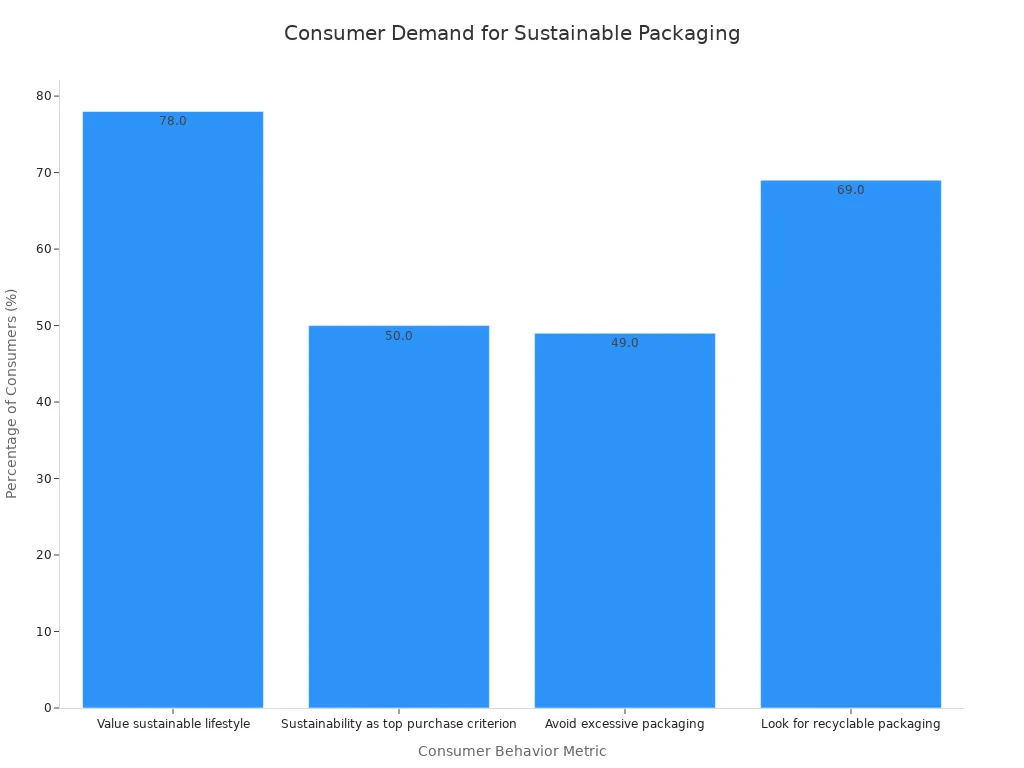
Consumer expectations have shifted. Meyers reports that 50% of consumers rank sustainability among their top four purchase criteria, based on Bain & Company data. Statista found that 49% of U.S. consumers avoid products with excessive packaging. The chart below, from Meyers, summarizes these preferences.
Regulation is tightening too. The European Union's Packaging and Packaging Waste Regulation covers design, recyclability, and compostability for specified applications. Extended Producer Responsibility laws make producers fund recycling systems, and evolving EPR legislation may not impact you now, but preparing now can prevent future compliance headaches. These rules reward businesses that adopt eco-friendly packaging early. Carbon footprint reduction also spans the supply chain: right-sizing cuts both materials and transport emissions. Working with experienced sustainable packaging solution providers helps you read these signals and act on them.
Start with data, not materials. A systematic current-state analysis quantifies the costs, functionality, and environmental impact of your existing packaging, according to Tacto. Build the baseline around four measures:
Total cost of ownership, including disposal fees and storage
Protective function across your transport conditions
Sustainability assessment based on lifecycle assessment principles
Cost-oriented KPIs such as packaging cost per product unit and the packaging share of total product price
Add sustainability and service metrics: recycling rate, CO2 footprint, share of sustainable materials, transport damage rate, and customer satisfaction with packaging quality. Tacto describes an automotive supplier that cut its packaging sizes from 47 to 12 standard formats and developed reusable transport containers with its main supplier. The results were 23% lower packaging costs, 35% less packaging waste, and 18% lower warehousing costs. The reusable containers paid for themselves after 14 months. Tacto notes that payback periods for new packaging investments typically run 12 to 24 months. Use this baseline to plan gradual process improvements rather than a single overhaul.
Excess space is the hidden cost driver. Void fill is the paper, air pillows, or foam that fills the gap between product and box wall, and Optioryx explains that the carrier bills that empty space through dimensional weight. A 2024 e-commerce study by Kandula, Roy and Akartunali found that more than one-quarter of a typical package's volume is air and filler. Optioryx gives a worked example: two items totaling 7.5 liters fit a 24-liter carton with 69% empty space, or an 11.25-liter carton with 33% empty space. The smaller carton needs 77% less void fill and ships 53% less volume. The Cary Company notes that matching products to best-fitting sizes minimizes empty space and reduces loose fill use.
Right-sizing pays in several ways, as Oliver Inc and Ranpak describe:
|
Benefit |
Detail |
|---|---|
|
Cost |
Lower shipping costs and dimensional weight charges |
|
Materials |
Less material waste and void fill |
|
Emissions |
Fewer packages per truckload lowers transport emissions |
|
Brand |
Stronger shelf presence and a better unboxing experience |
For a quick first win, consider switching from plastic to paper. Moving your business to sustainable packaging often begins with a simple swap from plastic packaging to a paper package on one line. Recyclable paper-based packaging runs on most existing lines, and paper-based packaging supports circular economy goals. Reusable materials suit closed-loop transport between your sites and suppliers. If you need guidance, sustainable packaging solution providers can map options against your volumes.
No single material wins everywhere. Uncoated paper performs poorly as a moisture, oxygen, and grease barrier, according to Packaged Sustainable. That limitation suits dry goods with modest shelf life. Flexible plastic delivers high barrier performance in thin formats, yet multilayer structures resist separation in recycling systems. The trade-off is real, and the right answer depends on your product.
Paper formats divide by application. Corrugated cardboard handles e-commerce boxes, appliances, and heavier products through fluted compression strength. Paperboard cartons suit cereals, cosmetics, and smaller electronics. Molded fiber fits inserts, trays, and blister replacements, though tooling costs and tolerances demand review. FSC-certified paper adds a chain-of-custody claim on top of these performance profiles.
Compliance varies by market. The EU Packaging and Packaging Waste Regulation (EU) 2025/40 covers design, recyclability, and compostability for specified applications, and EN 13432 sets industrial composting requirements, per Torise. In the United States, the FTC Green Guides govern environmental claims. Treat biodegradable and compostable as distinct terms. Ask suppliers whether certification covers the finished package, including inks and adhesives, or only the raw material.
Cost tracks volume and complexity. Reusable materials pay back in closed-loop transport between your sites and suppliers. Compostable formats carry certification costs. Recycled or recyclable packaging materials often cost less at scale.
Line speed is the first constraint. Environmentally friendly corrugates contain shorter paper fibers, and Bostik reports that these fibers hinder adhesive bonding, causing pop-opens and downtime. Test sustainable packaging materials on your existing lines before you commit. Record speed, tension, sealing temperature, waste, and changeover time during trials.
Piloting one product line limits risk. ISPE recommends clear success metrics for material performance, cost impact, and recyclability rates, plus a phased approach that feeds lessons into the broader strategy. Run the pilot, gather stakeholder feedback, then scale.
Bioflexi supports material selection and pilot design for sustainable packaging in manufacturing. The team helps you match eco-friendly materials to your equipment and validate performance before rollout. Many sustainable packaging solution providers offer similar guidance, and Bioflexi pairs it with hands-on pilot support.
Sustainable packaging in manufacturing rewards patience. Start with one line, measure results, and expand. That discipline turns sustainable packaging options into dependable green packaging solutions.
Your goals should tie directly to the numbers from your assessment. Packsize notes that most waste is created at the design stage, through oversized cartons and excessive filler. Accurate sizing cuts corrugate use and secondary materials at the same time. For high-volume shippers, small per-order reductions add up across the year. Reusable systems strengthen the financial argument further. The Plastics Industry Association reports that cost-per-use falls over time as durable formats need fewer replacements, and pooling models let companies share assets such as pallets and crates.
Build the business case for sustainable packaging around total cost of ownership, not sticker price. Pregis describes an automotive OEM that reframed its project as a ground-up redesign. The result was a 60% reduction in carton size and 800,200 lbs of waste avoided for every one million headlamps shipped. Lifecycle assessment data supports the same argument. Packaging Dive notes that lifecycle data helps you cut waste, improve transport efficiency, and meet emerging regulations. The EU PPWR and state EPR laws now reward early action, so compliance belongs in your projections.
Pick one line or a single material swap. EcoEnclose recommends small batch tests of 500 to 1,000 units for direct-to-consumer sellers, or a limited rollout at one fulfillment hub for larger operations. Track damage rates, pack times, cost changes, and customer feedback. The Boxery advises auditing current materials first, then prioritizing low-effort, high-impact swaps such as right-sized boxes and paper tape. Document results and scale in phases.
Customers need clear guidance on disposal. Groupo suggests explaining whether each format is recyclable, compostable, or reusable, since local recycling rules vary. Shorr found that 70% of consumers prefer clear sustainability labels, and the Recycling Partnership reports that 46% cite unclear labeling as a purchase barrier. Ask for feedback on every pilot shipment and refine your approach. Bioflexi supports pilots and helps you select eco-friendly packaging solutions that fit your equipment.
You now have a clear path: assess your current packaging, define goals tied to savings and demand, compare materials on performance, cost, and compliance, engage stakeholders, and pilot small changes. Moving your business to sustainable packaging is achievable without disrupting operations when you take these steps incrementally. Start with one packaging line, measure the results, and scale from there. Bioflexi can support material selection and pilot design as you expand, and many sustainable packaging solutions partners offer similar guidance.
Match the material to your product's barrier needs and your market's rules. Uncoated paper suits dry goods with modest shelf life. Flexible plastic delivers high barrier performance in thin formats. Test candidates on your own lines before you commit.
Payback periods for new packaging investments typically run 12 to 24 months, according to Tacto. Reusable containers in one reported case paid for themselves after 14 months. Your own assessment data gives the most reliable estimate.
EcoEnclose recommends small batch tests of 500 to 1,000 units for direct-to-consumer sellers. Larger operations can limit the rollout to one fulfillment hub. Track damage rates, pack times, cost changes, and customer feedback before you scale.
Tell customers whether each format is recyclable, compostable, or reusable, since local rules vary. Shorr found that 70% of consumers prefer clear sustainability labels. Ask for feedback on every pilot shipment and refine your approach.
Many sustainable packaging solution providers offer material mapping and pilot support. Bioflexi pairs material selection with hands-on pilot design. Ask any partner to validate eco-friendly packaging solutions on your equipment before rollout.
lf you would like to work with us or just want to get intouch, we'd love to hear from you!

Copyright @ 2026 Shanghai BioPouches Co., Ltd All Rights Reserved. Network Supported
leave a message