



Beef jerky and other dried meat snacks may look simple from the outside, but their packaging has an important job to do. Once meat has been dried, controlling moisture and oxygen becomes essential for protecting its texture, flavor, appearance, and shelf life.
For food brands, meat snack manufacturers, private-label companies, wholesalers, and importers, choosing the right beef jerky packaging is therefore more than a matter of selecting a bag size or printing a logo. The packaging structure needs to work with the product itself, the filling process, the expected shelf life, and the conditions the product will experience during storage and transportation.
Moisture and oxygen are two of the main factors to consider. A suitable flexible packaging structure can help limit moisture transmission and oxygen exposure while providing strong heat seals and enough mechanical protection for transportation and retail handling.
This guide looks at the main packaging considerations for beef jerky, dried beef, biltong, meat strips, and similar dried meat snacks, with a focus on moisture and oxygen barrier control.
Why Beef Jerky Packaging Needs Moisture and Oxygen Control
Drying reduces the water content of meat, but the finished product can still interact with its surrounding environment. If moisture enters the package over time, the texture of the jerky may change. A product that was originally firm and chewy may become softer or lose the texture expected by consumers.
Oxygen presents a different challenge. Exposure to oxygen can contribute to oxidation, which may gradually affect flavor, aroma, and color. This is particularly relevant for products containing fats or those designed for longer distribution and storage periods.
That is why high barrier meat packaging is often considered for dried meat products. The goal is to create a packaging structure that provides the level of protection required by the specific product without adding unnecessary material or cost.
There is no universal film structure that is automatically right for every jerky product. The appropriate solution depends on the recipe, water activity, target shelf life, pack size, storage conditions, filling equipment, and distribution environment.
What Makes a Good Beef Jerky Packaging Bag?
A good jerky pouch needs to balance several requirements at the same time. Barrier performance is important, but it is only one part of the finished package.
For most commercial applications, buyers should look at:
- Moisture barrier performance
- Oxygen barrier performance
- Light protection when required
- Heat-sealing strength
- Puncture and tear resistance
- Food-contact suitability
- Compatibility with the filling line
- Printing and surface finish
- Closure and resealing options
- Recyclability or other sustainability requirements
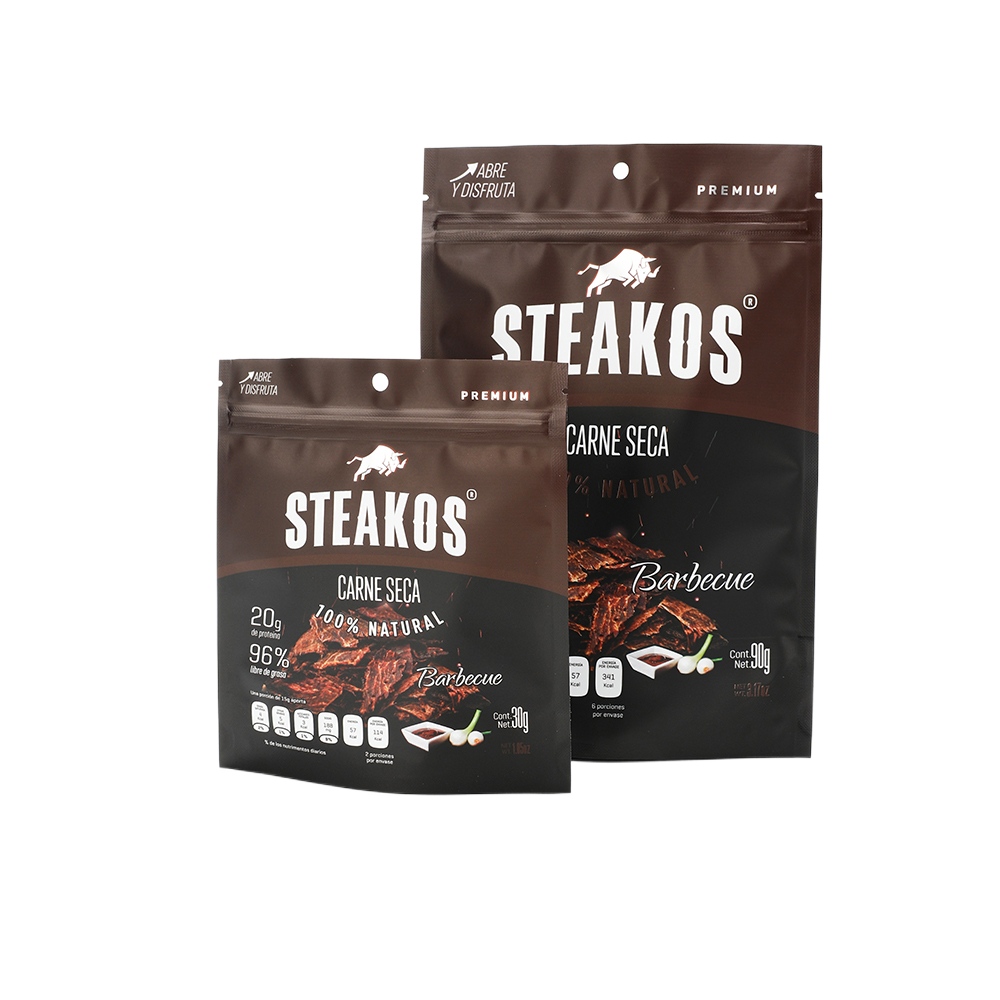
Bioflexi's beef jerky pouch is specifically designed for beef jerky and other dried meat products. The product page describes a high-barrier laminated structure designed to protect against moisture, oxygen, and light, with food-grade materials and heat-sealing capability.
The pouch can also be customized in terms of size, printing, material, surface finish, and additional packaging features.
Moisture Barrier: Protecting the Texture of Jerky
Moisture control is one of the most important considerations for dried meat packaging. Jerky is processed to reduce moisture, so unwanted moisture uptake can affect the final product characteristics.
For example, a jerky brand selling products in humid regions may face different packaging conditions from a brand distributing products through dry warehouses. Long-distance export shipments may also expose packages to changing temperature and humidity conditions.
The packaging material therefore needs to provide an appropriate moisture barrier for the actual distribution environment. It is not simply a question of choosing the thickest film available.
Seal quality also matters. Even when the film itself has good moisture resistance, a weak or inconsistent seal can create a pathway for moisture to enter the package.
For smaller portions, samples, or single-use meat snacks, a flat pouch can be a practical format. Bioflexi's flat pouch range includes options specifically intended for beef jerky and dried snacks, with resealable and high-barrier configurations available.
Oxygen Barrier: Why It Matters for Dried Meat
Oxygen can gradually affect the quality of many food products. With dried meat, prolonged exposure may contribute to oxidation and changes in flavor, aroma, or appearance.
For products with a longer intended shelf life, oxygen transmission should be discussed with the packaging supplier before the final material structure is selected.
Different laminated structures can provide different levels of oxygen protection. Depending on the application, manufacturers may consider structures using materials such as PET, PE, EVOH, metallized films, aluminum-based layers, or other barrier films.
However, the material should not be selected based solely on the name of a film. The final structure needs to balance oxygen barrier, moisture resistance, flexibility, sealing performance, production requirements, and sustainability goals.
For brands looking for more environmentally oriented packaging, Bioflexi also lists recyclable, compostable, PCR, and kraft paper material options. The exact structure should still be selected according to the required barrier performance and application.
Stand-Up Pouch or Flat Pouch for Beef Jerky?
The best pouch format depends on how the product will be sold and used.
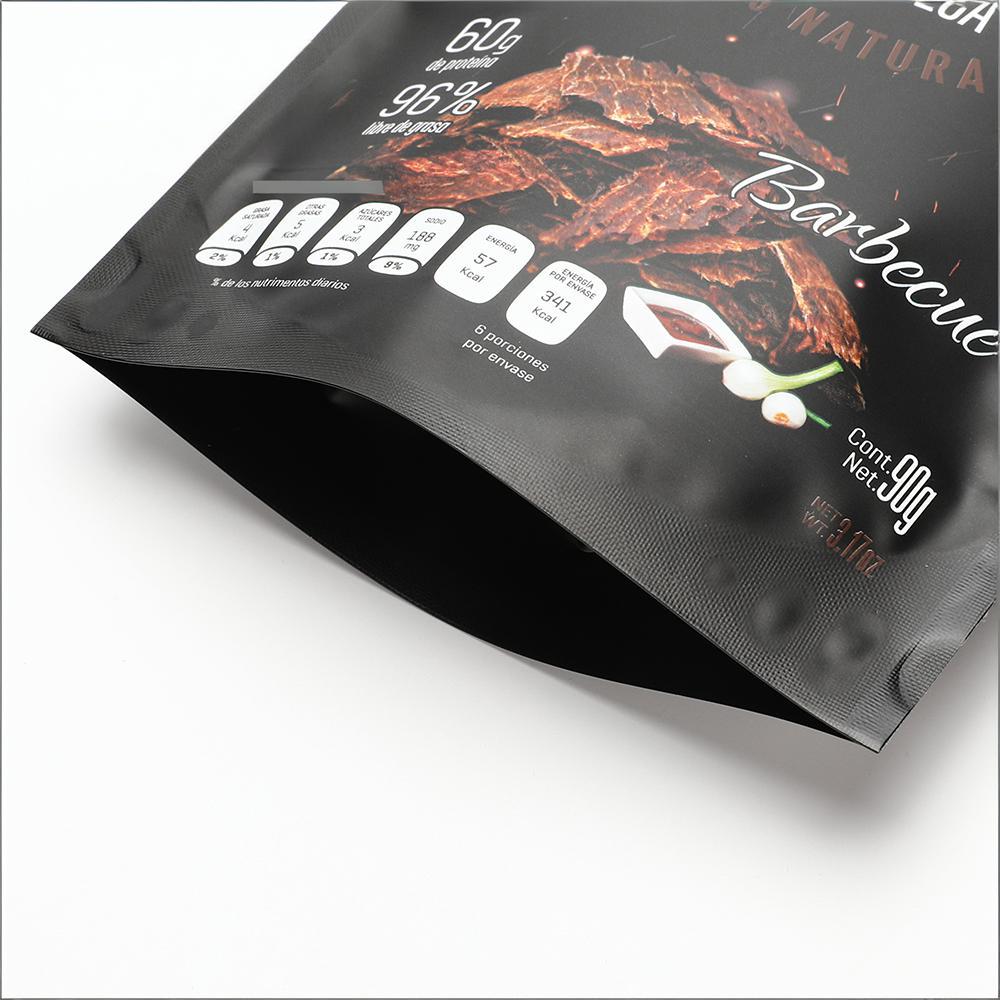
A stand-up pouch is particularly useful for retail applications because the bag can stand on a shelf and provide a relatively large printable area. This gives brands more room for logos, product photography, nutrition information, preparation instructions, and other packaging content.
A zipper can also be added when the pack is designed to be opened and closed several times.
A flat pouch is more compact and can be suitable for smaller portions, samples, trial packs, single servings, and products displayed with a hang hole. It can also be a straightforward option when a standing package is not necessary.
For buyers who want a smaller retail format, Bioflexi offers a jerky flat pouch with zipper and hang-hole options. The product is positioned for beef jerky and other dried snacks and can be customized for retail packaging applications.
How Zippers and Heat Seals Work Together
A zipper is useful for consumer convenience, but it should not be treated as the primary barrier of an unopened package.
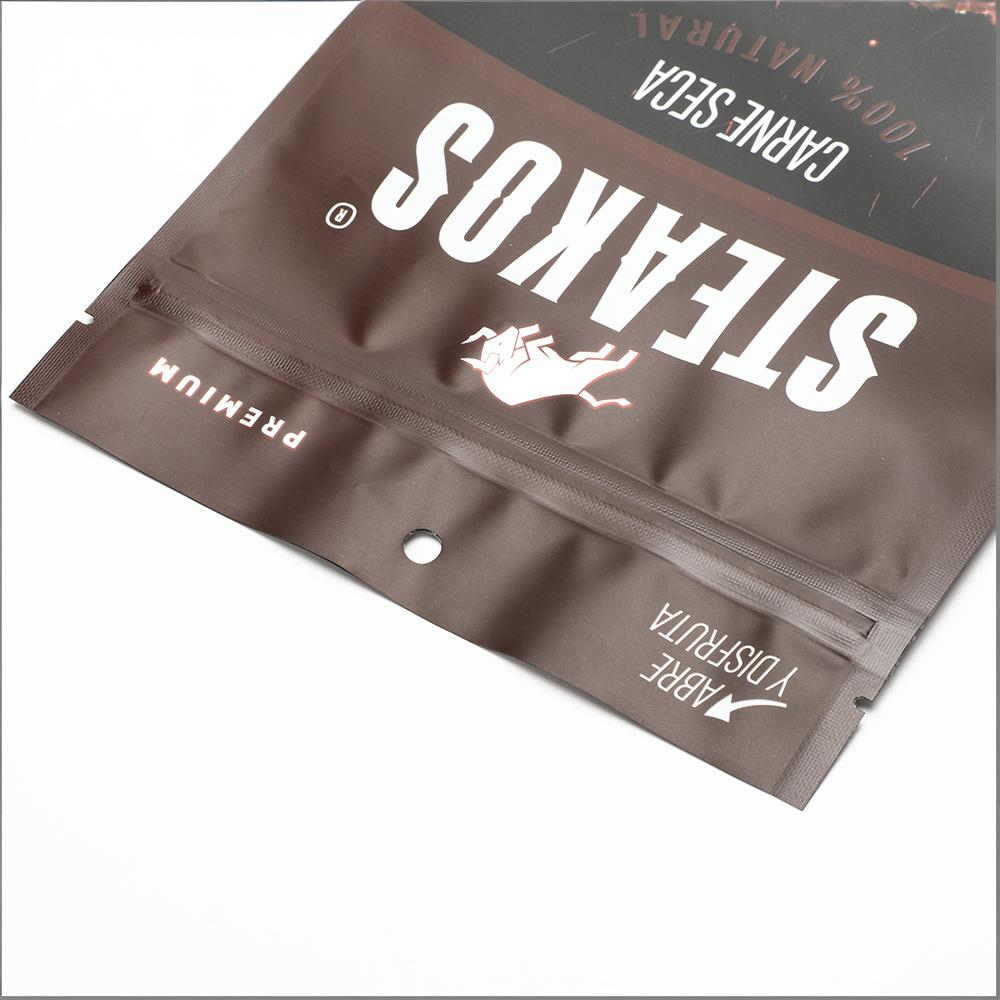
For many retail jerky bags, the original package is heat sealed after filling. The heat seal provides the initial closure, while a zipper can allow consumers to reseal the bag after opening.
This combination can be useful for larger packs that are not expected to be consumed immediately after opening.
Other optional features can include tear notches, hang holes, euro slots, windows, and different surface finishes. These features can be selected according to the product's positioning and retail environment.
Bioflexi's beef jerky stand-up pouch supports customized printing and finishing options, including matte, glossy, soft-touch, kraft paper effects, and other packaging finishes.
Choosing Packaging Materials for Dried Meat
Material selection should begin with the product requirements rather than a fixed preference for one film.
For example, a brand may prioritize high oxygen and moisture barrier performance because of its target shelf life. Another company may put more emphasis on recyclability while still requiring sufficient product protection.
Important questions to discuss with a packaging supplier include:
- What is the target shelf life?
- What are the storage conditions?
- Will the product be sold locally or exported?
- What is the required net weight?
- Does the product contain relatively high levels of fat?
- Does the filling line require a particular sealing structure?
- Is a zipper required?
- Does the brand require recyclable or compostable packaging?
- Will the package be exposed to strong light during retail display?
These details give the packaging manufacturer a better starting point for recommending a suitable structure.
Custom Printing for Beef Jerky Brands
Packaging is often the first physical interaction a customer has with a food brand. For jerky manufacturers and private-label companies, custom printing can help distinguish different flavors, product lines, and pack sizes while keeping the overall brand identity consistent.
Depending on the order volume and design requirements, buyers can consider rotogravure printing, digital printing, or flexographic printing.
Rotogravure printing can be suitable for larger production runs where consistent color reproduction and production efficiency are important. Digital printing is useful for smaller quantities, multiple designs, and products that need more flexibility during the launch or testing stage.
Bioflexi currently lists both rotogravure and digital printing options for its beef jerky stand-up pouch, allowing buyers to select a printing approach according to their order requirements.
Packaging Features Worth Considering
Custom jerky packaging can be designed around both product protection and consumer convenience. Depending on the application, buyers may consider:
- Custom pouch dimensions
- Different film thicknesses
- High-barrier material structures
- Matte or glossy surfaces
- Soft-touch finishes
- Transparent windows
- Resealable zippers
- Tear notches
- Hang holes or euro slots
- Spot UV
- Hot stamping
- Custom printed artwork
The right combination depends on the product's positioning. A premium retail jerky brand may want a soft-touch matte pouch with a strong visual finish, while a value-oriented snack brand may prioritize material efficiency and production cost.
What Wholesale Buyers Should Prepare Before Ordering
When requesting a quotation for custom beef jerky bags, providing complete specifications at the beginning can make the process much easier.
- Product: Explain whether the bag will be used for beef jerky, dried beef, biltong, meat strips, or another dried meat snack.
- Pack weight: Provide the target net weight, such as 30g, 90g, 100g, or another size.
- Bag format: Specify whether you prefer a stand-up pouch, flat pouch, or another format.
- Barrier requirements: Provide the target shelf life and storage environment if known.
- Closure: Indicate whether a zipper, tear notch, hang hole, or other feature is required.
- Artwork: Send the logo and packaging design if the artwork is already prepared.
- Quantity: Provide your estimated order volume so the manufacturer can recommend an appropriate printing method.
For example, Bioflexi's current beef jerky stand-up pouch page lists 30g and 90g example sizes, heat sealing, custom printing, and different material choices. The listed MOQ varies according to the production and printing method, so buyers should confirm the final specification when requesting a quotation.
Common Questions About Beef Jerky Packaging
What type of packaging is best for beef jerky?
The suitable packaging depends on the product, target shelf life, storage environment, filling process, and sales channel. High-barrier stand-up pouches and flat pouches are both practical options when the material structure is selected according to the product requirements.
Does beef jerky packaging need an oxygen barrier?
Oxygen barrier performance is an important consideration for many dried meat products because prolonged oxygen exposure can contribute to oxidation and quality changes. The required barrier level should be determined according to the formulation and intended shelf life.
Does jerky packaging need a moisture barrier?
Moisture control is important because dried meat can absorb moisture from its surroundings. The appropriate moisture barrier depends on the product, storage conditions, distribution environment, and required shelf life.
Can beef jerky bags be customized with a logo?
Yes. Custom jerky bags can be produced with brand artwork, different sizes, materials, surface finishes, and functional features such as zippers, tear notches, and hang holes.
Can beef jerky packaging be recyclable or compostable?
Depending on the required barrier and sealing performance, recyclable, compostable, PCR, and kraft-based packaging options can be considered. The final structure should be selected according to the product's technical requirements rather than sustainability claims alone.
Choose the Right Beef Jerky Packaging for Your Product
For beef jerky and dried meat products, packaging performance comes down to more than the appearance of the bag. Moisture barrier, oxygen barrier, sealing strength, material structure, pouch format, and distribution conditions all need to work together.
A stand-up pouch may be suitable for a branded retail product that needs shelf presence and resealability. A flat pouch can make more sense for smaller portions, samples, or compact snack packs. In both cases, the material structure should be selected around the actual product and shelf-life requirements.
For food brands, wholesalers, private-label companies, and importers, Bioflexi provides custom flexible packaging solutions with options for pouch format, material, printing, finishing, and functional features.
If you are sourcing custom beef jerky packaging, it is useful to provide your product type, pack weight, estimated order quantity, target dimensions, shelf-life requirement, artwork, and preferred pouch style when requesting a quotation. This gives the packaging manufacturer the information needed to develop a more suitable solution for your application.
Looking for Custom Beef Jerky Packaging?
Share your product type, pack size, quantity, artwork, and barrier requirements with Bioflexi to discuss a suitable pouch structure for your dried meat products.

 Network Supported