


Author
Marie R. Winters


Measuring a Side Gusset Pouch accurately ensures your product fits perfectly, maintains freshness, and looks appealing on the shelf. When you select the right dimensions, you protect against moisture and light, which extends shelf life and reduces waste. Selecting the right dimensions ensures your product stands out on the shelf. If you're still deciding on the best style for your brand, explore our full range of Custom Side Gusset Pouches to see various material and finish options.
A proper gusset size keeps the pouch stable and prevents tipping.
Increased internal volume accommodates heavier products and preserves product structure.
Durable materials help maintain freshness and enhance shelf appeal, leading to greater customer satisfaction.
Always consider product volume, weight, and required headspace before making your selection.
Accurate measurements of width, height, and gusset size ensure your product fits perfectly in the pouch, preventing waste and enhancing presentation.
Choosing the right gusset size increases internal volume, allowing for heavier products while maintaining stability and preventing tipping.
Consider headspace when measuring to ensure proper sealing and prevent leaks, especially for liquids and powders.
Use a ruler with millimeter markings for precise measurements, and always double-check to avoid costly errors.
Consult with packaging suppliers to confirm dimensions and avoid common mistakes, ensuring optimal packaging results.
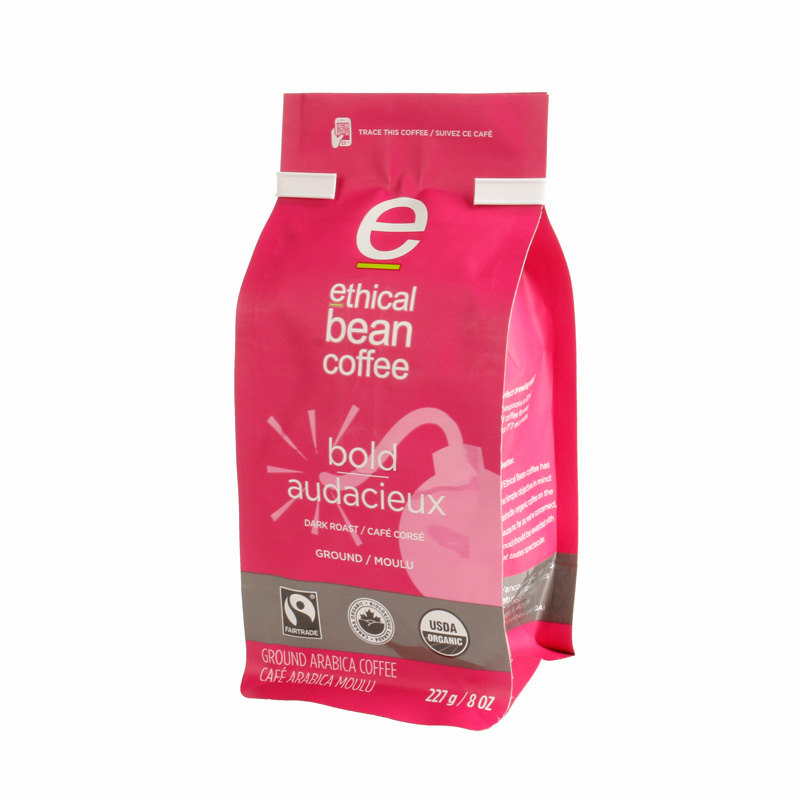
You encounter side gusset pouches in many industries because they offer versatility and strong shelf presence. These pouches stand upright due to their rectangular or square base, which gives your product stability and a professional look. The side gusset expands, allowing you to package larger volumes without sacrificing space efficiency. Compared to other flexible packaging types, side gusset pouches deliver superior expansion and visual appeal.
|
Feature |
Side Gusset Pouches |
Other Flexible Packaging Types |
|---|---|---|
|
Design |
Stand upright due to rectangular/square base |
Varies, may not stand upright |
|
Gusset Type |
Side gusset allows for expansion |
Bottom gusset or no gusset |
|
Aesthetic Appeal |
Attractive on retail shelves |
Depends on design, may not be as appealing |
Manufacturers use a range of materials to construct these pouches. You benefit from options like PET for printability and strength, PE for food-contact and heat sealing, PA for puncture resistance, aluminum foil for high oxygen and light barriers, EVOH for transparent gas barriers, and compostable films for eco-friendly solutions.
|
Material |
Function |
|---|---|
|
PET (Polyester) |
Printability and strength |
|
PE (Polyethylene) |
Food-contact, heat seal |
|
PA (Nylon) |
Puncture resistance |
|
Aluminum Foil |
High oxygen/light barrier |
|
EVOH |
Superior gas barrier (transparent) |
|
Compostable films (PLA, PHA) |
Biodegradable options |
Accurate measurement ensures your product fits perfectly inside the pouch. If you misjudge the size, you risk inconsistent servings, which can lead to customer dissatisfaction and product returns. Oversized pouches increase shipping costs and may cause damage during transit. When you select the right size, you reduce waste and improve customer satisfaction.
Inconsistent servings can lead to customer dissatisfaction, prompting returns.
Excessive packaging contributes to waste, especially if it does not match the actual product volume.
Oversized packaging can lead to increased shipping costs and potential damage to products.
You achieve optimal packaging results by measuring carefully and choosing the correct pouch size. This approach protects your product, enhances its presentation, and supports sustainability goals.
You need to accurately measure the width, height, and gusset size of a recyclable side gusset pouch to ensure your packaging fits your product. Start by laying the pouch flat on a clean surface. Use a ruler or caliper for precise measurements. Follow these steps:
Measure the Width
Place the pouch flat. Measure across the front panel from one side seam to the other. Keep the gusset tucked in. This gives you the true width.
Measure the Height
Measure from the bottom seal to the top edge along the center of the pouch. Exclude any zippers or tear notches. This step ensures you capture the usable height.
Measure Gusset Size
Locate the folded side panel. Measure from the fold to the outer edge of the gusset. Repeat for both sides if the pouch has double gussets. Add both gusset depths together for total gusset size.
Expert Tip: At Bioflexi, we offer fully customizable dimensions. Whether you need an extra-deep gusset for bulky items or a specific height for retail racks, our engineering team can adjust templates to your exact specs.
Here is a table summarizing recommended tools and measurement types:
|
Measurement Type |
Description |
Example |
|---|---|---|
|
Width |
Across opening of the bag (with gusset tucked in) |
8 inches |
|
Gusset |
Depth or Distance across the open face of side pleat |
5 inches |
|
Length |
From the opening to the bottom of the bag |
10 inches |
|
Gauge |
Thickness of bag, measured in mils |
0.002 inches |
|
Bag Size |
Written as: Width x Gusset x Length x Gauge |
8” x 5” x 10” 2 mil |
When measuring the length and width, always use a ruler with millimeter markings for greater accuracy. Measuring the bottom gusset requires careful attention to the fold and outer edge.
Industry standards help you select the right gusset size for your product. Manufacturers often list pouch sizes as Width x Gusset x Height. Gusset depth varies based on capacity and product requirements. You can reference the following table for common gusseted bags:
|
Width (mm) |
Height (mm) |
Side Gusset (mm) |
Capacity (grams) |
|---|---|---|---|
|
80 |
260 |
25+25 |
250 |
|
140 |
210 |
35+35 |
250 |
|
85 |
360 |
30+30 |
500 |
|
150 |
230 |
40+40 |
500 |
|
135 |
390 |
40+40 |
1000 |
|
195 |
275 |
45+45 |
1000 |
|
170 |
493 |
55+55 |
2000 |
|
210 |
510 |
55+55 |
3000 |
|
Other sizes available on request |
|
|
|
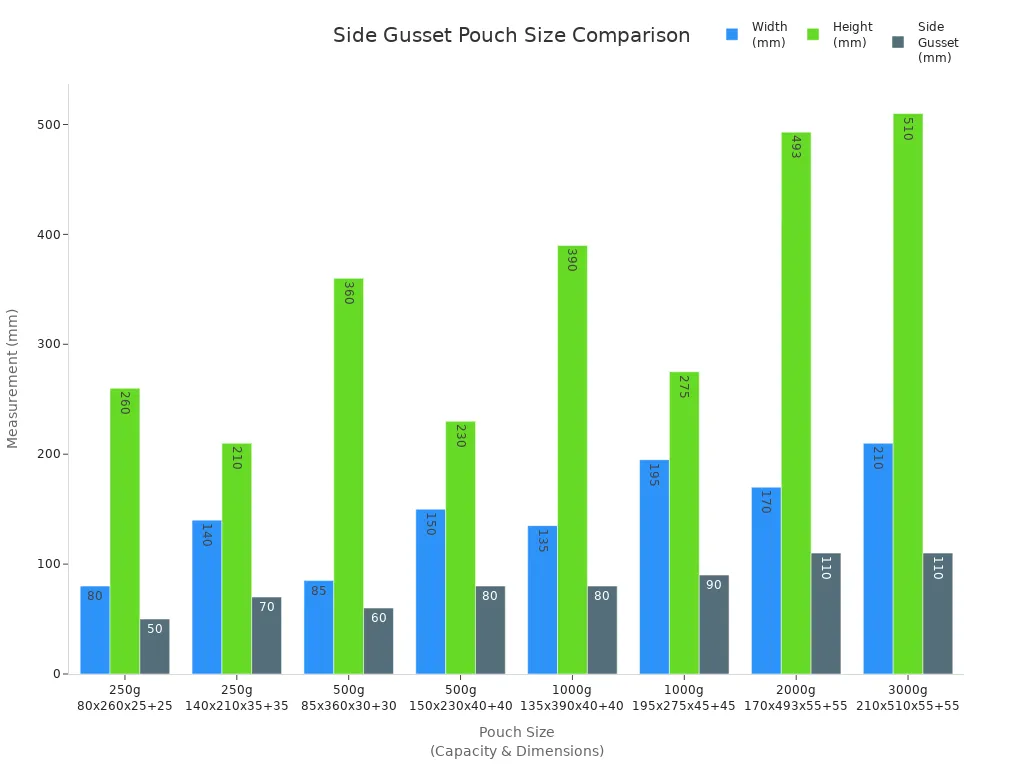
You must measure gusset size carefully. Gusset depth directly affects the internal volume and stability of the pouch. For example, a 40+40 mm gusset means each side panel expands to 40 mm, giving a total gusset size of 80 mm. When you measure gusset size, always check both sides for symmetry.
You can avoid costly mistakes by following best practices. Many errors occur when you misread gusset depth or forget to account for headspace. Here are common pitfalls and how to prevent them:
Misreading Gusset Depth:
Always measure from the fold to the outer edge. Do not include the seam. Double-check both sides for consistency.
Ignoring Headspace:
If you fill the pouch too high, you risk contaminating the seal area. Headspace allows for proper sealing and prevents leaks. It also accommodates expansion, especially for liquids during shipping.
Note: Not accounting for headspace can compromise the sealing area. Filling machines require a clean zone to apply heat seals. Without headspace, the pouch may burst if liquids expand during transit.
Incorrect Measuring the Length and Width:
Measure along the center of the pouch. Exclude zippers and notches. Use outside dimensions for accuracy.
Overlooking Gusset Size Variations:
Gusset size may differ between manufacturers. Always confirm the gusset depth and total gusset size before ordering.
Measuring the Bottom Gusset Instead of Side Gusset:
Side gusset pouches have gussets on the sides, not the bottom. Measuring the bottom gusset can lead to incorrect dimensions.
You achieve optimal packaging results when you accurately measure all dimensions. Measure gusset size with care, and always double-check your measurements. This approach ensures your product fits perfectly and maintains quality throughout the supply chain.
You must start by calculating the volume your product requires. This step ensures you select a side gusset pouch that fits your packaging needs. You can use several methods to estimate the volume. For most products, the cuboid formula works well:
Volume = Height × (Width + 2 × Gusset Depth) × Gusset Depth
This formula considers the height, width, and gusset depth. You measure each dimension accurately to avoid errors. For pouches with complex shapes, divide the pouch into geometric sections such as prisms or cones. Calculate each section’s volume separately and sum them for the total capacity.
If you package products with irregular shapes, you may need to use 3D modeling software for the most precise results. For standard products, the truncated prism formula gives a reliable estimate. Always check the theoretical volume against the actual product to ensure a proper fit.
Tip: Use reference products to test the fit before finalizing your order. Product density affects the required pouch size. Lightweight items often need larger pouches than their weight suggests, while denser products fit more compactly.
You must choose gusset size based on your product’s characteristics. The gusset design increases storage capacity and enhances shelf appeal. A larger gusset creates a stable base, allowing the pouch to stand upright. This feature improves shelf presentation and attracts consumer attention.
Bulky or uneven products benefit from a deeper gusset. For example, granola or snacks require a gusset between 80 and 120 mm. Powders and protein supplements need more headspace due to trapped air. You may need a gusset of 100 mm or more and a wider overall width to maintain stability and prevent settling.
When you choose gusset size, consider industry ratios. The gusset depth should match the width and height for optimal stability. You can reference recommended pouch sizes to guide your selection. Always confirm the gusset dimensions with your supplier to avoid discrepancies.
|
Product Type |
Recommended Gusset Size (mm) |
Stability Benefit |
|---|---|---|
|
Granola, Snacks |
80-120 |
Stable base, upright stand |
|
Powders, Supplements |
100+ |
Prevent settling, air space |
|
Coffee, Tea |
40-80 |
Compact, shelf appeal |
|
Pet Food |
80-120 |
Bulk fit, easy access |
Note: The gusset size determines how much product you can pack and how the pouch stands on the shelf. A well-chosen gusset size improves both product accessibility and branding.
You must adjust pouch size calculations for product weight and headspace. Heavier products require reinforced gusset dimensions to prevent bulging or tearing. Lightweight products may need extra gusset depth for stability.
Headspace is essential for sealing and product expansion. You must allow enough space above the product to ensure a clean seal and prevent leaks. Industry guidelines recommend different headspace percentages based on product type:
|
Product Type |
Recommended Headspace |
|---|---|
|
Solids |
5-10% of product height |
|
Powders |
15-20% to allow settling |
|
Liquids |
10-15% to prevent seal stress |
|
Vacuum Pouches |
2-5% for effective evacuation |
You must also consider adjustments for packaging issues:
Add 2-3 mm width for bulging sides.
Reduce headspace or adjust fill to prevent wrinkled seals.
Reinforce corners to prevent tearing.
Tighten size tolerances to avoid machine jams.
Callout: Headspace should remain less than 30% of the pouch height. Maximum lightweighting helps reduce material usage while maintaining functionality.
You achieve optimal packaging results when you measure all dimensions, choose gusset size carefully, and adjust for product weight and headspace. This approach ensures your pouch fits your product, stands upright, and meets your packaging needs.
You need to reference standard pouch sizes when selecting packaging for your product. Manufacturers offer a range of side gusset pouch options to fit different weights and volumes. The following table provides a quick overview of common pouch sizes, including both metric and imperial measurements. This chart helps you compare width, length, and gusset dimensions for various capacities.
|
Volume |
Width (mm) |
Width (in) |
Length (mm) |
Length (in) |
Gusset (mm) |
Gusset (in) |
|---|---|---|---|---|---|---|
|
2 oz |
51 |
2 |
190 |
7 1/2 |
32 |
1 1/4 |
|
4 oz |
68 |
2 2/3 |
226 |
8 7/8 |
42 |
1 5/8 |
|
8 oz |
90 |
3 1/2 |
260 |
10 1/4 |
70 |
2 3/4 |
|
16 oz |
96 |
3 3/4 |
330 |
13 |
77 |
3 |
|
2 lbs |
136 |
5 1/3 |
420 |
16 1/2 |
77 |
3 |
|
3 lbs |
140 |
5 1/2 |
445 |
17 1/2 |
80 |
3 1/8 |
|
5 lbs |
178 |
7 |
490 |
19 1/4 |
115 |
4 1/2 |
|
10 lbs |
280 |
11 |
623 |
24 1/2 |
130 |
5 1/8 |
|
20 lbs |
408 |
16 |
820 |
32 1/4 |
140 |
5 1/2 |
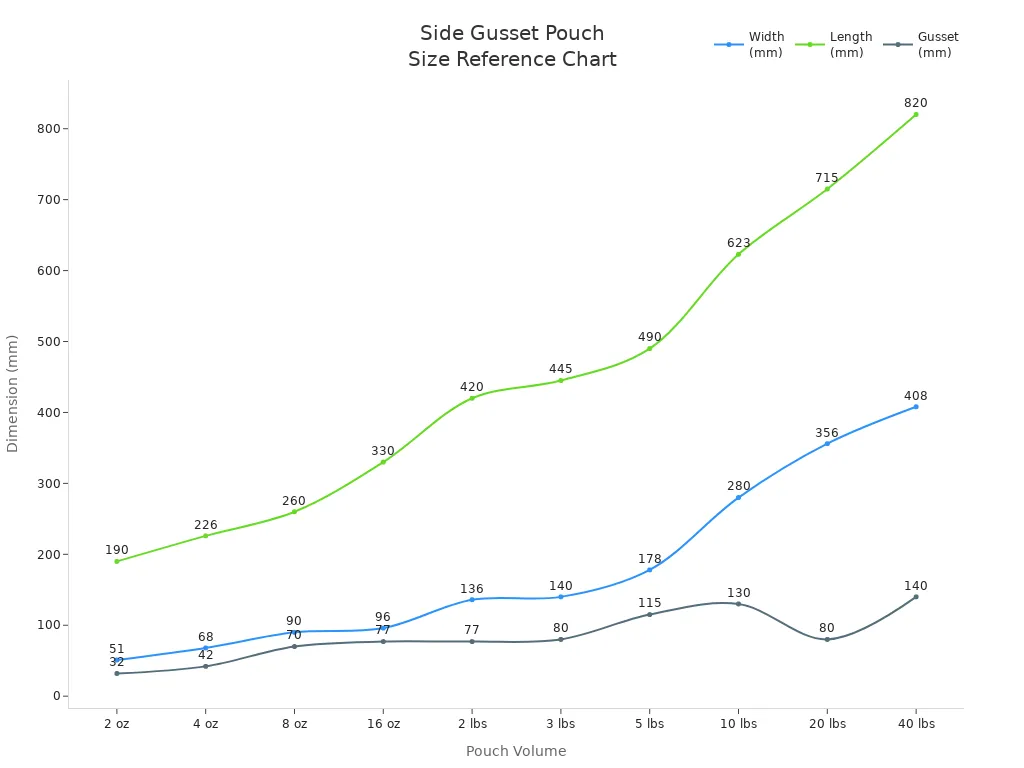
You can use this chart as a reference when performing accurate measurement and comparing essential measurements for your product.
You must match the pouch size and gusset dimensions to your product’s requirements. Different industries rely on specific side gusset pouch sizes to ensure product stability and shelf appeal. Here are typical applications:
Snack foods often use pouches sized 5″ x 7″ x 3″, holding 2–6 oz. The gusset provides enough volume for chips or granola while keeping the pouch upright.
Bulk dry goods, such as rice or beans, fit well in 8″ x 10″ x 4″ pouches, supporting 16–32 oz. The gusset increases capacity without making the pouch too tall.
Liquids and sauces require 4″ x 8″ x 3″ pouches, which hold 8–12 oz. The gusset allows for expansion and prevents leaks.
Powdered supplements use 6″ x 9″ x 3″ pouches, accommodating 8–16 oz. The gusset ensures easy scooping and resealing.
You should consider how the gusset enhances internal volume and stability. For example, uncooked rice fits in a ¼ gallon pouch, which holds about 6.5 oz or 1 cup. The gusset allows the pouch to stand upright, improving product visibility on shelves.
Tip: Choosing the correct gusset size can improve shipping efficiency and reduce costs. One company reduced shipments by 30% and saved over $500,000 annually by optimizing their pouch design.
When you select the right side gusset and pouch size, you ensure your product fits securely, stands out on the shelf, and ships efficiently. Always use essential measurements and accurate measurement techniques to achieve the best results.
You achieve optimal packaging results when you measure side gusset pouches accurately and select the right size for your product. Precise measurement protects your items, enhances presentation, and prevents costly errors. Review the key factors in the table below:
|
Measurement Dimension |
Description |
|---|---|
|
Width |
Measured from the horizontal ends of the bottom gusset or the back of the pouch. |
|
Height |
Measured from the top end of the pouch until the bottom part of the gusset. |
|
Gusset |
The space that your item fills inside the pouch, measured from the longer ends. |
Always double-check your measurements and consult with packaging suppliers for clarity.
Consulting with packaging suppliers helps you avoid common sizing mistakes and ensures accuracy in your pouch dimensions.
You improve product protection and shelf appeal by following these best practices.
You measure the gusset depth by laying the pouch flat and measuring from the fold to the outer edge of the gusset. Repeat this for both sides. Add both measurements for the total gusset size.
You use a ruler with millimeter markings or a digital caliper for precise results. Clean, flat surfaces prevent distortion. Avoid stretching the pouch during measurement.
Headspace allows you to seal the pouch properly and prevents leaks. It also accommodates product expansion, especially for powders and liquids. You protect your product and ensure a secure seal.
Standard sizes work for many products, but you must consider your product’s volume, weight, and shape. Custom sizes may suit unique items better. Consult your supplier for recommendations.
You should avoid misreading gusset depth, ignoring headspace, and measuring the bottom gusset instead of the side gusset. Double-check all dimensions before placing your order.
lf you would like to work with us or just want to get intouch, we'd love to hear from you!

Copyright @ 2026 Shanghai BioPouches Co., Ltd All Rights Reserved. Network Supported
leave a message