

Author
Marie R. Winters


Custom flat pouches are flexible bags sealed on all four sides, and they package food, cosmetics, and household goods at low cost. The right materials, size, and printing combination depends on three factors: product protection, branding goals, and budget.
Bioflexi supplies custom flat pouches across multiple materials and print options. This guide offers practical, vendor-neutral education, so readers can specify custom pouch packaging with confidence. Start with one question: what does the product need from its package? A clear answer guides every later choice, from film structure to artwork. Buyers who define that need first avoid costly revisions and receive accurate quotes for lay flat pouches that fit both the product and the shelf.
Custom flat pouches are flexible bags sealed on all four sides. They package food, cosmetics, and household goods at low cost.
Choose the right material based on product needs. Foil gives the strongest barrier. Plastic film works for many items. Paper and compostable options fit sustainability goals.
Measure a filled sample to find the correct pouch size. Fill weight alone is not enough. Density and volume matter.
Match the printing method to your order size. Digital printing suits small runs. Flexography works for medium runs. Rotogravure is best for large orders.
Keep artwork away from seal bands. Ink in the seal area can weaken the bond. Use templates to avoid mistakes.
Approve a physical sample before full production. A sample shows how the film feels and how colors look. It also checks capacity.
Flat pouches cost less and save space compared to stand-up pouches, flat bottom pouches, and boxes. They work best for simple, affordable packaging.
Flat pouches are simple flexible bags sealed on all four sides. They hold products in a flat, space-saving shape. Manufacturers offer them in different sizes and materials, so they suit a wide range of goods. A buyer can order a custom flat pouch in a clear film, a white barrier film, foil, or paper. Each option changes how the package protects the product inside.
These bags work well for solid items, small parts, and single servings. A custom flat pouch keeps packaging costs low and still carries a brand message. The format also fits automated filling lines and manual packing tables alike. That flexibility explains why so many brands choose custom pouch packaging for their first retail launch.
Cost is the first advantage. Flat pouches use less material than rigid containers, and they weigh very little. Lower weight reduces shipping charges and fuel use across the supply chain. The flat profile also saves warehouse space, because stacked pouches compress into a small footprint. Retailers appreciate the same trait on crowded shelves and in backroom storage.
Branding is the second advantage. A large printable panel covers most of the front surface. That panel gives artwork room to breathe. Custom printed flat pouches can carry logos, ingredient lists, and regulatory text without crowding. The format also accepts matte or glossy finishes, so a brand can match the look of its wider product line.
Food producers use flat pouches for snacks, coffee samples, dried fruit, and single-serve ingredients. The barrier film protects flavor and extends shelf life. Cosmetics brands pack masks, cotton pads, and sample sachets in the same format. Household goods makers seal hardware, sponges, and refill tablets inside lay flat pouches. Each industry picks a film that matches its product's sensitivity.
Lay-flat pouches also serve markets outside retail. Promoters hand out samples at events, and subscription clubs mail small items in printed bags. A lay flat pouch fits these jobs because it stores flat and opens easily. Buyers who compare custom flat pouch options across industries will find the same core benefits: low cost, light weight, and strong branding space.
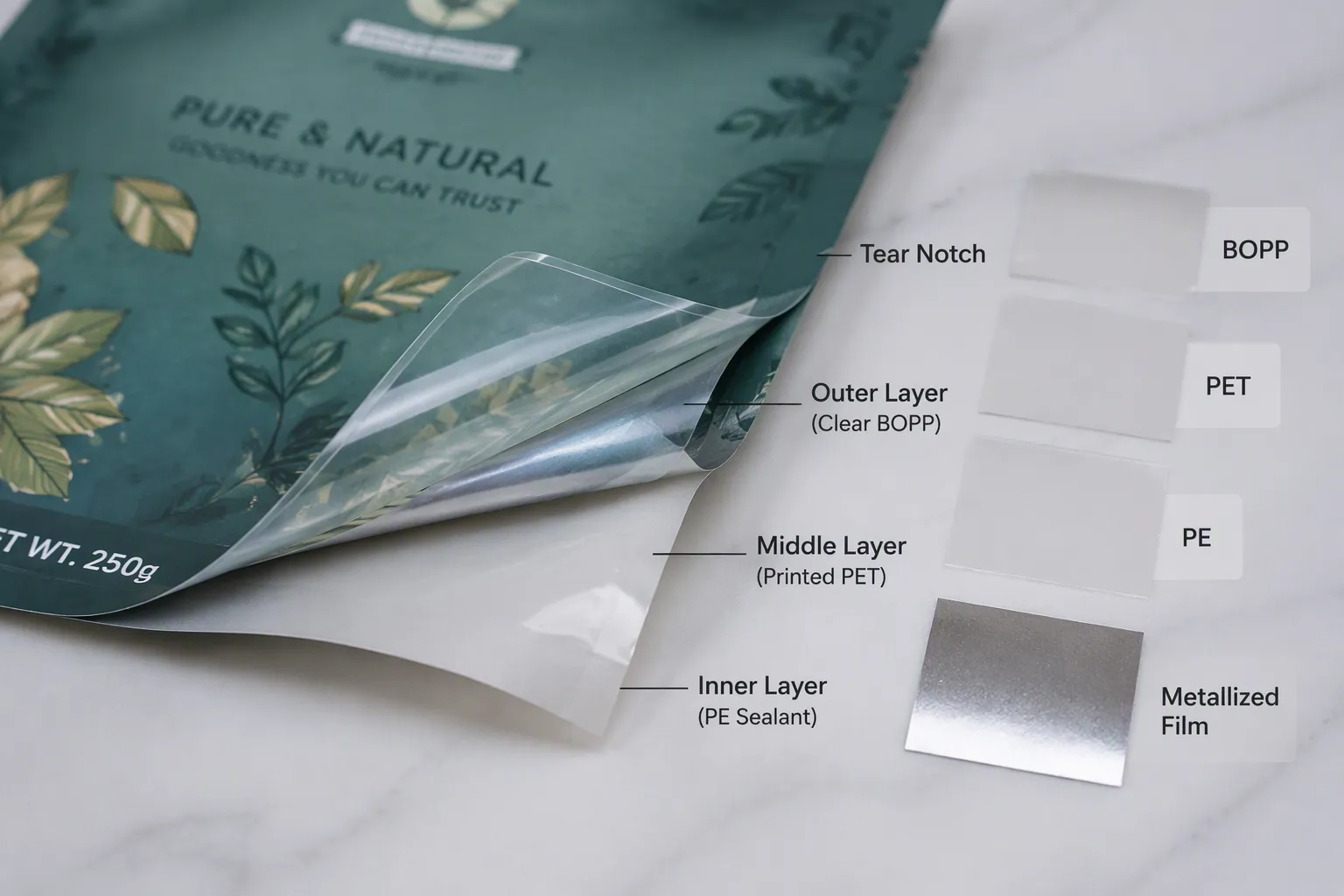
Film and closure choices should follow the product's needs. Barrier level, shelf life, and feel all point toward a specific structure. A high-barrier white film suits products that need strong protection and a clean white background for artwork. Clear structures suit visible products. A flat pouch usually closes with a fin seal or a lap seal, and a tear notch helps the user open it cleanly. The sections below cover the main families of pouch materials and show where each one fits best. Custom flat pouches rarely need the heaviest barrier, and they rarely need the lightest one either.
Plastic film forms the backbone of most flat pouches. Each layer plays a distinct role.
|
Plastic Film |
Typical Role / Function |
|---|---|
|
Clear BOPP |
Outer layer — high gloss, crisp appearance, good printability |
|
Clear PET (BOPET) |
Outer web — higher stiffness, dimensional stability, premium look |
|
PE |
Sealing layer — reliable sealing and softness |
|
CPP |
Inner layer — seal performance, clarity, toughness |
|
EVOH / ALOx |
Barrier structures — added shelf life while keeping transparency |
Common clear structures include BOPP/CPP, BOPP/PE, and PET/PE. Nylon adds a strong oxygen barrier and high temperature resistance, though its water vapor barrier is poor. Metallized films such as MetPET and MetOPP carry a thin aluminum coating of about 0.5 microns. That coating lifts barrier performance well above plain plastic while keeping the package transparent. EVOH and ALOx structures add shelf life without losing clarity. LLDPE seals more strongly than LDPE but shows higher haze. MBOPP carries a metalized layer on a BOPP base with double heat-sealing layers.
Lay flat pouches suit candies, biscuits, samples, single-serve powders, and simple retail items. Buyers choose them when cost, machine speed, or compact packaging matters more than shelf-standing performance. The format also runs fast on form-fill-seal equipment, which keeps output high for high-volume snack lines. Custom printed flat pouches in clear film let shoppers see the product, which helps for colorful snacks and sample sachets. A white high-barrier film serves the same jobs when the product needs light protection.
Aluminum foil delivers the strongest barrier of any common pouch material. A solid foil laminate such as PET/Al/PE reaches a moisture vapor transmission rate below 0.002 g/m²/24h and an oxygen transmission rate below 0.1 cc/m²/24h. Both figures rate as excellent. Pharmaceutical laminates typically use foil from 7 to 25 microns thick. Once the foil passes 20 microns, it is generally regarded as pinhole-free, and water vapor transmission becomes essentially zero. Foil also blocks UV light, oxygen, and microbial contamination. AlOx clear barrier variants offer similar protection with product visibility. Metallized film sits in the middle, with a moisture vapor transmission rate of 0.01 to 0.10 g/m²/24h and an oxygen transmission rate of 0.5 to 2.0 cc/m²/24h. A clear nylon/PE structure reaches 0.30 to 1.00 and 2 to 10 respectively. Standard polyethylene alone passes more than 5.00 and more than 50, which suits only short-life goods.
Foil flat pouches fit pharmaceuticals, long-term storage goods, and products sensitive to light or humidity. Coffee, dried foods, and nutraceuticals also benefit. The near-zero moisture transmission keeps the internal microenvironment dry across the full shelf life. That trait matters for drugs distributed in hot, humid climates.
Kraft paper gives flat pouches a natural look and pairs especially well with flexography printing. Kraft suits coffee bags, tea packaging, matcha powder bags, and organic food pouches. Pet food bags in kraft come in sizes from 30 g to 15 kg. Natural food, bars, and protein powder also use paper-based structures. Brands that want a visible window can combine kraft with a clear film layer.
Compostable structures fit sustainability goals without asking buyers to give up protection. PLA works for window bags, dry food packaging, tea pouches, and snack pouches. PLA also forms the clear window layer in kraft paper bags with windows. PBAT suits stand-up pouches, snack bags, and flexible packaging films that need better flexibility. Both materials serve food packaging, daily care products, beauty products, and pet food bags. Choosing the right material among these options comes down to the product's sensitivity and the brand's disposal story.
Selecting among typical pouch materials starts with one question: what does the product need? The answer narrows the field quickly. Buyers who compare materials for printed flat pouches side by side will see that each family trades barrier strength against cost, feel, and environmental profile. Custom flat pouch packaging works best when that trade-off matches the product inside.
A common standard size, 3.25" x 4.5", holds about 1.5 oz of flour or 1 oz of coffee beans. That example shows how one pouch serves different products at different weights. Standard size options cover many everyday fills, and they ship faster because the tooling already exists. Buyers with a simple product often start there.
Custom sizes matter when a product does not fit a stock dimension. A brand may need a taller panel for artwork or a wider mouth for scooping. Custom flat pouches in custom sizes solve both problems. The right choice depends on the fill, the shelf plan, and the print layout, not on habit.
The filled-sample method gives accurate dimensions before ordering. A buyer fills a pouch by hand with the real product, then measures the filled width, height, and gusset. Next, the buyer adds tolerance for the seal area and headspace. Sealing and zipper closures need 20–30% headspace, so a fill that reaches the brim calls for one size up.
Capacity is determined by the product being filled, not by the pouch itself. The same 5 x 8 inch pouch might hold two ounces of dried herbs for one brand and eight ounces of ground coffee for another.
This step also tests the customer experience. The buyer opens, pours, and recloses the lay flat pouch as a shopper would. Irregular items such as jerky strips or hardware do not settle like granules, so density math fails and a physical fill wins. Sizing from a filled sample ensures accurate dimensions before a full run begins.
Fill weight alone cannot pick a pouch. Density and volume drive the answer. Dense rice and light cereal can weigh the same and still need very different bags. The table below shows how two products fill the same pouch at different weights.
|
Pouch Size (W x H) |
Volume |
Coffee Beans (Weight) |
Flour (Weight) |
|---|---|---|---|
|
3.25" x 4.5" |
1/4 cup |
1 oz |
1.5 oz |
|
4" x 6" |
1/2 cup |
2 oz |
3.5 oz |
|
5" x 7" |
1 1/4 cup |
4 oz |
8 oz |
|
7" x 9" |
4 cups |
11 oz |
1 lb 8 oz |
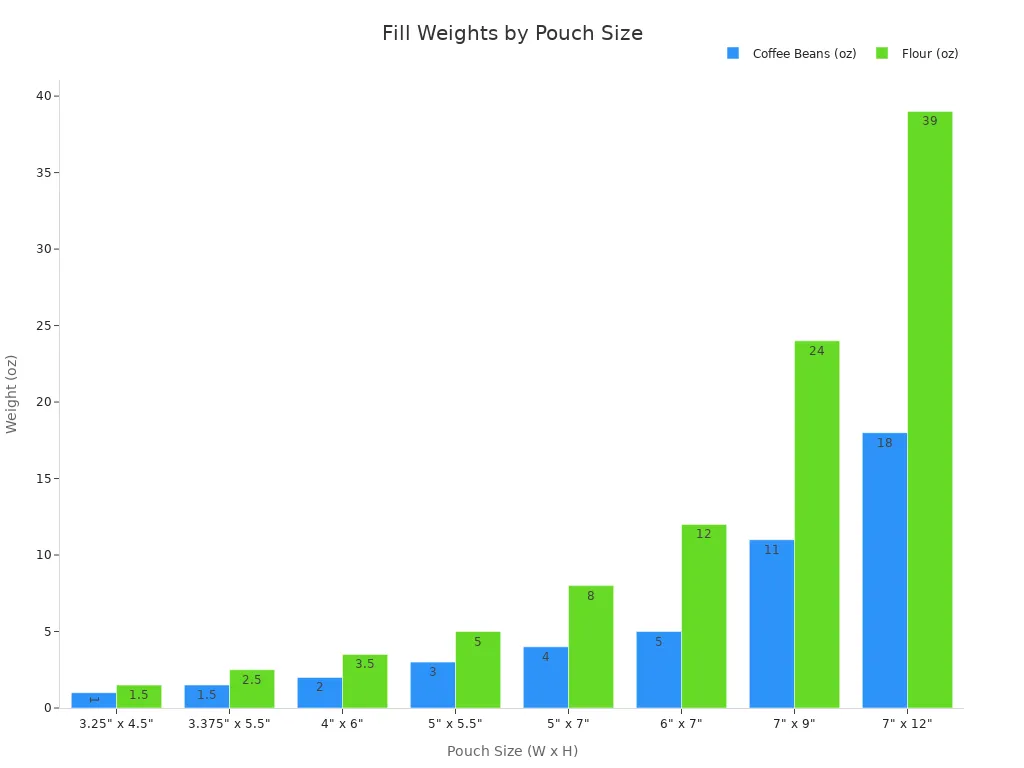
Several factors shape the final size. Product form and piece size affect flow near the zipper. Mouth access decides how easily a user pours or scoops. The filling route, manual or automatic, changes the specification too. No universal chart exists, so custom flat pouch packaging should follow the actual product volume. Buyers who test a fill and confirm the numbers get lay flat pouches that seal cleanly and display well.
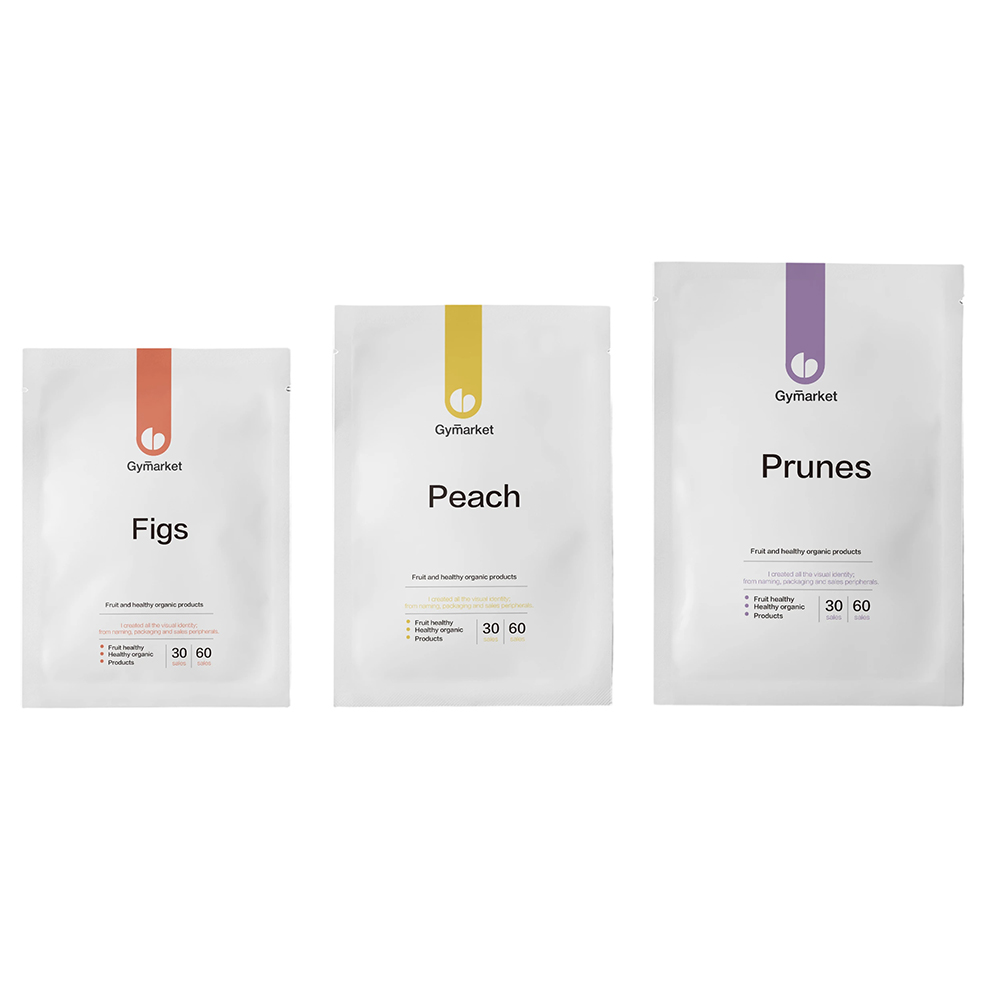
Printing turns a plain film into a brand asset. Three methods dominate the market: flexography, rotogravure, and digital. Each one fits a different order size, design complexity, and budget. The right choice depends on the job at hand, not on a universal ranking. Buyers who understand where each method performs best can specify custom printed lay flat pouches with confidence.
Flexography is the most commonly used pouch printing technique. The process uses flexible embossed plates and quick-drying inks. That combination works across paper, cardboard, and flexible films, so it suits most custom printed lay flat pouches. Kraft material pairs especially well with this method, which makes it a natural fit for paper-based printed flat pouch designs.
The method offers clear advantages for medium to large print runs:
Flexible plates and fast-drying inks handle paper, cardboard, and flexible films with ease.
Print quality stays excellent while the cost per unit remains economical at medium to large volumes.
Setup times run significantly shorter than gravure, so orders move through production faster.
Shorter setup gives production planners more flexibility when schedules shift.
A brand that orders custom printed lay flat pouches in steady mid-volume batches will find flexography a practical workhorse. The plates cost less to prepare than engraved cylinders, and the press runs quickly. Sharpness sits slightly below gravure, a trade-off most buyers accept at this volume tier. For custom lay flat pouches that need solid coverage and reliable color, flexography delivers dependable results run after run.
Rotogravure suits high-volume orders that demand premium print quality. Each color needs its own engraved cylinder, so an 8-color design roughly doubles the setup cost of a 4-color one. Ink mixing and press setup add further expense before the first pouch leaves the line. Those fixed costs spread across volume. At 50,000 units, setup dominates the price. At 1,000,000 units, it barely registers, and the per-pouch cost drops steeply.
|
Category |
Details |
|---|---|
|
Typical applications |
Food, coffee, snack, frozen food, pet food, personal care, pharmaceutical, and household packaging |
|
Typical pouch formats |
Stand-up pouches, lay flat pouches, flat bottom pouches, sachets, stick packs, and printed rollstock |
|
Initial costs |
Cylinder engraving per color, plus ink mixing and press setup |
|
Per-unit behavior |
Fixed costs spread over volume, so unit price falls as quantity rises |
|
Reorders |
Existing cylinders skip engraving, which improves return on investment |
Spot and PMS colors are hand-mixed for an exact match, with little to no color variance, and the shop can save those colors for the next run. The method generally yields the lowest per-unit cost on runs of 5,000 or more pouches. Common jobs include granola, candy, coffee, cannabis, and industrial packaging. The best fit depends less on industry and more on order size. Above 100,000 units per SKU, rotogravure usually wins on unit cost. Regular reorders of one design reach that point sooner. Brands ordering custom printed lay flat pouches at this scale gain rich color, high consistency, and a durable finish.
Digital printing fits short runs and complex designs. The process needs no plates or cylinders, so setup cost is zero and plate-making delays disappear. Short and medium runs become practical, and brands can respond to real-time demand without holding excess inventory. Design changes cost little, because a new ingredient list or logo is just a new file. Seasonal, promotional, and test-market batches run without large orders or SKU limits. Variable data adds unique codes or graphics per pouch, which supports personalization and track-and-trace.
|
Printing Method |
Best For |
Advantages |
Limitations |
|---|---|---|---|
|
Digital |
Small runs and test markets |
No plate cost, quick turnaround, easy design changes |
Limited color depth, less economical for long runs |
|
Flexographic |
Medium runs |
Versatile, economical, works on many materials |
Slightly lower sharpness |
|
Gravure |
Large-volume orders |
Rich color, high consistency, durable finish |
Higher setup cost for cylinder engraving |
Order size guides the decision. Under 25,000 units per SKU, digital usually costs less. Between 25,000 and 100,000 units, color count and reorder likelihood decide the winner. Above 100,000 units, rotogravure usually wins. A brand testing several designs can order custom printed pouches digitally, then move the winning design to flexography or gravure for scale. This staged path keeps printed packaging pouches affordable at every stage. Buyers comparing custom printed lay flat pouches across methods should match the process to the run, not the other way around. A single custom printed pouch sample run also lets a team check color and layout before committing to a larger order.
Materials, style, and design should align with both product needs and branding goals. A pouch that protects well but looks wrong on the shelf fails half its job. The design stage is where protection and presentation meet, and buyers who plan custom flat pouches design early avoid reprints later.
The closure decides how a shopper uses the pouch. Single-use products suit a straight heat seal, the cheapest and strongest option, which the buyer tears or cuts open. A tear notch adds a small V-cut in the seal edge for a clean hand tear at very low cost. Multi-use products need a resealable zipper, a press-to-close track under the top seal that adds material cost and slightly reduces printable area. A tamper-evident top seal sits above the zipper and tears off first, so the first opening is obvious while the zipper stays reusable. A hang hole or euro slot punched in the top seal lets the pouch hang on a peg board instead of sitting in a bin.
|
Closure / Opening Type |
Description |
|---|---|
|
Straight heat seal |
Cheapest and strongest closure; buyer tears or cuts it open; suited to single-use products. |
|
Tear notch |
Small V-cut in the seal edge enabling a clean hand tear; very low cost and improves ease of opening. |
|
Resealable zipper |
Press-to-close track under the top seal for multi-use products; adds material cost and reduces printable area slightly. |
|
Tamper-evident top seal |
Heat seal above the zipper that is torn off first, keeping the zipper reusable while making the first opening obvious. |
|
Hang hole / euro slot |
Punched in the top seal so the pouch can hang on a peg board rather than sit in a bin. |
The right choice follows the use case, not the price list. A sample sachet needs no zipper, while a coffee pouch sold for repeat brewing does. Buyers who order custom printed flat pouches should match each closure to the way shoppers will actually open and store the product.
Matte and glossy finishes change how a pouch reads. Matte reflects less light, which makes labels easier to read, and research found packaged food perceived as more natural in matte packaging; consumers also expected it to taste better and were more likely to buy. Glossy remains the default for barrier pouches because it is ultra-durable and vibrant, and it allows clear windows for high-energy products like candy.
Durability differs too. Matte hides minor scratches and fingerprints better, while glossy shows them more easily. Glossy coatings repel liquids and resist UV fading; matte may absorb moisture over time and fades faster in sunlight. Header cards add another shelf tool, because they lift a flat pouch into a hanging display and boost presence. Smart custom flat pouch packaging balances these effects against the product's handling and display plan.
Artwork placement protects the seal. Heat and pressure must bond film to film across the seal bands, and ink in that zone can weaken the bond. Designers should keep all text, logos, and images clear of every seal area on the dieline.
Templates make this easy. A printer's template shows exact seal zones for each of the available sizes, so artwork lands where printing is safe. Reviewing the proof against the template catches bleed errors before plates or cylinders are made. Good custom flat pouches design treats the seal band as a no-ink zone from the first sketch, and that habit keeps printed lay flat pouches sealing reliably. Teams that order custom printed pouches in several sizes should confirm each dieline separately, since seal zones shift with pouch dimensions. Lay flat pouches reward this discipline with clean seals and crisp graphics.
The order flow follows a predictable path. A buyer chooses the desired size and color options for the custom flat pouches first. Next comes the quantity and the artwork or logo files for printing. A design mockup then goes back to the buyer for review before the order is finalized. Checkout and shipping preferences close the loop, and bulk orders follow the same steps with volume pricing and confirmed delivery timelines.
Templates remove guesswork from the artwork stage. A buyer browses customizable templates that match the brand aesthetic, then personalizes the chosen layout with unique graphics, text, and color schemes. A preview of the customized template confirms the design before the final file moves forward. This step matters for custom flat pouch packaging, because the dieline decides where ink can safely land.
Quotes depend on size, materials, quantity, and print method. Buyers who request a quote with a finished template and a clear quantity get accurate pricing faster. Bioflexi supplies templates for each available size, so artwork lands inside the safe print zone from the first draft.
A proof catches errors before plates or cylinders are made. After uploading artwork, a buyer can request and download a free PDF proof from the Shopping Cart or My Account after checkout. The proof must be approved from My Account before printing of the order begins. That approval step protects both sides, since a missed typo or a shifted logo becomes costly once production starts.
Reviewers should check spelling, color callouts, and seal band clearance on every panel. The proof also confirms the print method and the material choice. A signed-off proof becomes the reference for the full run of printed lay flat pouches.
A physical sample settles questions that a PDF cannot. Buyers can request a Custom Pouches Sample Kit to evaluate material quality, print clarity, and overall appeal before making final design decisions. The kit shows how film feels in hand and how colors read on the actual substrate.
Bioflexi provides pre-production samples to confirm fit and print quality. Approving a physical sample before full production is the strongest safeguard against surprises. A filled sample also verifies capacity, so the finished flat pouches hold the intended fill weight. Teams that order custom printed pouches in several sizes should sample each one. This final check keeps custom flat pouches true to the approved design.
Flat pouches fit best where a brand needs simple, affordable packaging with efficient storage. They store flat, ship light, and print across a wide front panel. A buyer comparing formats should match the pouch to the product and the shelf, not to a trend. Each alternative below solves a different problem well.
Stand-up pouches rely on a gusseted bottom to stand upright, and both formats hold their shape well. The stand-up style offers more versatility, because an expandable gusset adapts to a wider range of product shapes and sizes. A brand selling loose granola or chunky pet treats often prefers that flexibility. Both formats accept zippers or spouts for resealing, so closure choice rarely decides the comparison.
Flat pouches win on cost and storage. They use less material, stack into a small footprint, and run fast on filling lines. A sample sachet or a single-serve snack rarely needs to stand on a shelf. Buyers who order custom flat pouches for these jobs keep packaging spend low. The stand-up format earns its higher material use when shelf presence matters more than unit cost.
Flat bottom pouches help products stand out on crowded shelves. A flat base gives strong stability and self-standing ability, and the larger flat surface area suits prominent graphics and branding. Brands can choose from a range of sizes, materials, and finishes to match a premium look. That combination makes the format a strong pick for coffee, supplements, and gift sets.
Flat pouches serve a different role. They suit simple, affordable packaging with efficient storage, and they carry branding well across a broad panel. A printed lay flat pouch still delivers clear graphics at a lower material cost. The right pick depends on the display plan. A pegboard or a bin favors the lay flat pouch, while a shelf facing the shopper favors the flat bottom design.
Boxes provide rigid protection and strong shelf display. A carton shields fragile items from crushing and holds its shape on a shelf. It also offers six printable panels for artwork and regulatory text. A brand selling glass jars or stacked goods often needs that structure.
Flat pouches trade rigidity for weight and cost savings. They compress for storage, ship at low weight, and seal against moisture with the right film. Flexible custom pouch packaging also uses far less material than a carton. Many brands combine both formats: a box for the retail unit and a lay flat pouch for the inner wrap. Each format fits its own job, and neither replaces the other across every product.
Materials, size, and printing work as one decision. Protection needs set the film, fill volume sets the dimensions, and order size sets the print method. Budget and branding goals then fine-tune the result. Readers ready to move forward should fill a sample, measure it, confirm the print quantity, and request a quote. Bioflexi supplies templates, samples, and a custom quote for custom flat pouches. Contact the team to review materials for lay flat pouches, plan custom printed flat pouches, and finalize custom pouch packaging. A short conversation turns these flat pouches into a finished spec, and one approved sample protects the whole run of custom pouches.
Flat pouches fit snacks, coffee samples, dried fruit, cosmetics samples, and small hardware. They also work for single-serve powders and event giveaways. The format suits solid items and single servings. Buyers pick it when cost, compact storage, and a large printable panel matter more than shelf-standing performance.
Foil delivers the strongest barrier. A solid foil laminate such as PET/Al/PE blocks moisture, oxygen, and UV light. Metallized film sits in the middle. Standard polyethylene suits only short-life goods. Buyers should match the film to the product's sensitivity and expected shelf life.
Fill a pouch by hand with the real product. Measure the filled width, height, and gusset. Add tolerance for seals and headspace. Sealing and zipper closures need 20–30% headspace. A 3.25" x 4.5" pouch holds about 1.5 oz of flour or 1 oz of coffee beans. Density and volume drive the answer, not weight alone.
Digital printing fits short runs and test markets. It needs no plates or cylinders, so setup cost is zero. Design changes cost little. Under 25,000 units per SKU, digital usually costs less. A brand can test several designs, then move the winner to flexography or rotogravure for scale.
Rotogravure suits high-volume orders that demand premium print quality. Each color needs its own engraved cylinder, so setup costs run high. Above 100,000 units per SKU, rotogravure usually wins on unit cost. Existing cylinders skip engraving on reorders, which improves return on investment.
No. Heat and pressure must bond film to film across the seal bands. Ink in that zone can weaken the bond. Designers should keep all text, logos, and images clear of every seal area on the dieline. Templates show exact seal zones for each size.
A physical sample settles questions that a PDF cannot. It shows how film feels in hand and how colors read on the actual substrate. A filled sample also verifies capacity. Approving a sample before full production is the strongest safeguard against surprises in custom flat pouch packaging.
Flat pouches trade rigidity for weight and cost savings. They compress for storage, ship at low weight, and seal against moisture with the right film. Flexible packaging also uses far less material than a carton. Boxes still win for rigid protection and fragile items. Many brands combine both formats.
lf you would like to work with us or just want to get intouch, we'd love to hear from you!

Copyright @ 2026 Shanghai BioPouches Co., Ltd All Rights Reserved. Network Supported
leave a message